Showing posts with label Arts and Entertainment. Show all posts

Wednesday, February 13, 2008

Not so fantastic.

So there I was, at the library and absolutely thrilled to be holding a copy of the new Doctor Who Encyclopedia. I'm not a huge Whovian--those legions of fans who dissect every episode of the BBC's long running sci-fi series. But having fallen big time for the new series, I was eager to see if the Encyclopedia would help fill me in on all the lore and oddities of the original series going back to 1963, as well as give me some insight into the making of the show.

Alas, it was not to be. I got it home and soon realized, to my disappointment, that rather than being a history of the series, or even a guide to the individual episodes, the Encyclopedia was simply a collection of the most minute factoids of each episode--essentially a massive collection of trivia. Annoyingly, the book only covers the new series, from 2005 onward. Its arrangement of subjects in alphabetical order is helpful if memories need refreshing while watching episodes (in cases, I suppose, when one can't rest until the question of the Face of Boe's age is finally settled). But for the novice, it's t00 much information. To author Gary Russell's credit, each definition is exhaustively dealt with (Russell is involved with the show's script writing). The Encyclopedia is lavishly illustrated with stills from the series, some of which are better in quality than others. Each definition cites pertinent episode(s), and where applicable, which actor portrayed a character.

Still, it feels like a missed opportunity. It's really hard to imagine anyone other than the most diehard Whovians taking an interest in this particular format. Looking at Amazon, I see that there is a Doctor Who: The Inside Guide, which is probably more what I had in mind when I picked up the Encyclopedia. But that book also ignores the earlier series. Apparently it has to fall to some other entity or fan to write the definitive history of the show, as the BBC doesn't seem to be interested in doing it.

Thursday, December 13, 2007

The beautiful voice in print.

If you were to ask people in the know about the goings on of the opera world, they would probably agree that Renee Fleming is the closest artist that could be called current American diva. Especially after the release of her most current disc, Homage: The Age of the Diva, it would appear that Fleming herself isn't adverse to the title. So it perhaps shouldn't come as a surprise that Fleming has released (in 2004) The Inner Voice: The Making of a Singer: a memoir, not of her life, but of her voice.

It's an interesting concept, but one that has some inherent problems. For instance, where does the voice end and the singer begin? How does such a book different from a singing how-to (or even an extended voice coaching session)? Opera singers sometimes like to refer to their voices as 'instruments,' a concept that almost makes the singer and the voice two distinct entities. Fleming herself has noted that she doesn't like to think of her voice in that manner, but there is the sense from Inner Voice that we're getting a lot on the voice and not so much on Fleming herself. Much of the book reads like the responses to a very friendly interviewer, leaving the singer herself somewhat distant. There's a little bit of confusion over to whom the book is being addressed as well. Fleming offers considerable advice and examples of how she produces her sound and how to avoid the fatigue and vocal damage that often plagues classical singers. Puzzlingly, some simple musical terms, such as legato, are defined in the text, suggesting an audience with little formal training. Yet more difficult concepts ('tessitura') receive no explanation.

On the positive side, Fleming writes with a down-to-earth sensibility that immediately dispells any notion of the stereotypical touchy diva. If Inner Voice suffers from some a lack of focus, at least one can say that it is a breeze to read, and the moments where Fleming does get into some personal history offer honest, engaging depictions of the hectic life of an opera star. As such, I'm still glad that I took the time to read it. Die-hard Fleming fans, voice students and opera enthusiasts interested in the 'how it's done' aspects of singing would probably find The Inner Voice most satisfying. Fleming's artistry and career are likely important enough to encourage future books; perhaps she'll write a more traditional memoir in the future. In the meantime, this interview and performance on MPR's Saint Paul Sunday provides a satisfying portrait of the artist.

Saturday, February 24, 2007

Forget the stickman--cue the gunman.


In no less than three places in and on The Big Show: High Times and Dirty Dealings Backstage at the Academy Awards, is a terse statement: 'This book is not affiliated with the Academy of Motion Picture Arts and Sciences.' This little disclaimer is vital, lest the reader assume that the Academy (those folks behind the Oscars) wanted to reveal the inner workings of its annual bash. From the stage, it's all glamour and stars, a night where the film industry gathers to recognize those deserving films that epitomize the art of cinema.

Whatever. Anyone who's ever sat through an entire Oscar telecast (admit it, you've done it, and you cheered when Titanic won) has to know that whomever is involved in mounting the production has to have a few loose marbles by the time it's all done. Thanks to Steve Pond, we now have proof. Pond (he's the one between Chris Cooper and the very pregnant Catherine Zeta-Jones in the back flap photo) gained backstage access to over a decade's worth of Oscar productions, revealing a process that tries sanity and could be reasonably blamed for at least one premature death. The story here isn't so much the stars, although there is plenty of humanizing (and demonizing) tidbits about them. Rather, Pond concerns himself more with the people planning the show, revealing the struggles to do the impossible: bring the show in at a three hour duration, avoid any nasty surprises from overly profane or political winners (or hosts) and ban the tedious thank-you lists from winners determined to have their minute (or five or ten) in the spotlight.

Pond reveals some surprising and humourous aspects to the show, such as the ticklish situation presented by the explicitve-laden nomination of "Blame Canada" for best song, and the potential for the use of rubber bullets in case some acceptance speeches carry on too long. In retrospect, the powers that be behind Oscar might have regretted pulling back the curtain for Pond's little book, but certainly with all the disclaimers, no one will be the wiser, right? At any rate, when you tune in on the 25th for the 79th incarnation of the Oscar bash, keep your fingers crossed for anyone who goes too far over the time limit--they may be in the crosshairs.

Thursday, February 15, 2007

How the 0.0046% live.

I'll admit it: I love looking at home decor books. Not so much for the decoration or design of the places (let's face it--it's unlikely I would ever be able to afford the contents of a single room, much less an entire house), but for what the homes reveal of their owners. In most cases, the homes in such books are owned by very wealthy, but fairly anonymous figures. Architectural Digest, however, occassionally features homes of the rich and famous, thereby merging star oggling with the voyerism of looking at their homes.

Part of viewing other people's homes is the smugness that comes with assessing their tastes, and in that sense Hollywood at Home does not disappoint. Never a town (or nowadays, industry) known for restraint, many of the homes easily reflect their owners' larger than life personalities. The best example of excess goes to Jayne Mansfield's infamous Pink Palace, with its bathroom boasting pink shag carpeting on every flat surface (including the ceiling), but is also apparent in Cher's Italian Renaissance villa overlooking the beach, John Travolta's hangar-like home (complete with runway) or Jack Warner's 9-acre estate. Still, for every gargauntuan spread, there's a home that almost looks like mere mortals could reside within its walls. Not surprisingly, these most often belong to Hollywood stars of the past--James Stewart, Katherine Hepburn and Danny Kaye's seem almost quaint in their homey style.

The quality of the essays and photos varies across the book. Some essays concern themselves with the architectural or decorative characteristics of the house, while a few seem more like mini biographies of the famous occupant. The selection of homes is nicely mixed (including some in New York, New England and Ireland), as is the mix between old and new. Some stars are included for who they are rather than for their homes (Marilyn Monroe is here, in spite of the poor quality of images of her homes). But the point of Hollywood at Home's large, glossy format is for display on a coffee table or persual during viewings of Entertainment Tonight, and in that sense it serves its purpose admirably.

Saturday, July 29, 2006

Bibliomane dies and goes to book cover heaven.

As a reader and a librarian, it would be good of me to adhere to the old maxim of not judging a book by its cover, and focus instead on the quality of the text inside. But reality usually has a way of eschewing such sampler-type wisdom, and no where is that more true in the bottom-line driven world of book design. Happily, in the right hands, a book can become its own work of art while staying faithful to ideas between its covers, and Chip Kidd: Book One: Work: 1986-2006 is a fabulous collection of just how beautiful a book as an object can be, from one of today's best designers.

In all honesty, I had no idea who this Kidd guy was prior to reading another glowing review of this book, and was only intrigued because of the promise of book cover art. When I picked it up at the local library, and started paging through its 400 pages of artwork, I had to laugh to myself, because it quickly appeared that this designer was responsible for some of the most appealing, memorable covers in recent publishing history. At times iconic, humourous, literal, controversial, intense, and exuberant, Kidd's work, to paraphrase the words of one author, uses a few symbols or images to capture the essense of complex literature.

Aside from the beautifully recreated cover art, Kidd provides humourous, insightful notes about each cover design, along with examples of source material and covers that never made it to the bookshelf. Various authors weigh in on what they liked (or didn't like) about the images for their books. Book One also offers a look into the usually tumultuous world of book publishing, especially at Knopf, where Kidd began his career twenty years ago. While hefty, Book One is entirely engrossing, and I had trouble putting it down. In the hands of anyone with an interest in publishing, design, art or books, Kidd's album is likely to have the same effect.

Friday, July 21, 2006

Art history? Bio? All of the above?

I'm not sure that Jonathan Harr's The Lost Painting: The Quest for a Caravaggio Masterpiece could really be cataloged under any one subject. Weaving elements of art history and biography into the tale of the rediscovery of the lost Caravaggio masterpiece The Taking of Christ, Harr's work sometimes reads like a detective story. While I was reading it, I honestly couldn't put it down, but it was more a couldn't put it down because I wanted to get to the aha moment. It proved somewhat elusive, although there were good moments along the way: the discovery of a mention of the painting in a 17th century ledger, the excitement felt by an amateur art historian as he gazes on the neglected masterpiece, and the descriptions of the volatile man who created it. But it all seemed somewhat, well, padded. There's a little bit of everything: descriptions of art restoration techniques, a bit on Caravaggio, a brief lament over the state of upper education in Italy. The Lost Painting is an interesting concept, but I had a sense that there could be more to the story that Harr's book sort of missed. It's an interesting concept that anyone interested in art would find a diverting read, but for those who want to find out more about Caravaggio or the world of art history, they may find the bibliography to be more useful.

Sunday, June 25, 2006

A bona-fide star performance.


Unlike the last book I found while browsing at Memorial, Lee Server's new biography of Ava Gardner was not at all difficult to get through, in spite of its 500 pages of text. Ava Gardner: "Love Is Nothing" moves along swiftly and with as much spirit and vest as its subject. Today, Gardner isn't as well known an actress as her contemporaries Grace Kelly and Katharine Hepburn, but at the height of her career (late 1940s-50s), Gardner was the femme fatale of Hollywood. Her private life often topped her on-screen persona: much of her notoriety came from her affair with the then-married Frank Sinatra, but previous marriages to Mickey Rooney and Artie Shaw had already set the pattern for Gardner's heady and reckless love life.

Server has a lot to work with, detailing Gardner's rise from the North Carolina backwoods to through her rise to stardom and her slow decline as she became disillusioned following failed movies and love affairs. A combination of mistreatment by her studio (MGM almost made it a point to cast her in terrible films) and insecurity about her acting skills led Gardner to develop a legendary drinking habit, even for alcohol drenched Hollywood. In time, her destructive lifestyle would leave her restlessly wandering, searching for a permanent home and a man who wouldn't break her heart. In spite of her flaws though, Gardner remained a compelling figure. Server brings this aspect of the actress alive through a writing style that echoes Gardner's often ironic tone and extensive, explicative-filled quotes from Gardner and those who knew her.

I really didn't have much familiarity with Gardner's work, only having seen her in Mogambo and Show Boat a long time ago. In a way, though, Gardner's greatest dramatic turn was in the making of her own life, with held as much melodrama and triumph as any screen saga. Like the best type of director, Server frames his star so that her character can shine through to tell her own story. And for both author and star, it is a great performance.

Thursday, June 15, 2006

Out of the closet.


I have a confession to make.

For the past few months, I have been an abject, utterly devoted, borderline-obsessive fan of Sex and the City. In fact, the past few minutes between me writing that sentence and creating the link to the show was spent aimlessly browsing through the fashion shots on the official site. Every evening at 10 o'clock finds me devotedly tuned in to the WB to see the criminally censored, yet still appealing re-re-runs of episodes that I've already essentially committed to memory. Of course, when faced with such an inexplicable possession, there's really only one course of action to take:

It must be analyzed to death.

Which brings me to the topic(s) of today's post. I mined the library resources I had available to me, and spent the last week and a half reading. I started with Candace Bushnell's original book of the same title. I'd heard mixed reactions from fans of the show, so I knew not to expect the same stories, or even the same characters. Still, Bushnell's sharp, cynical prose takes some adjusting to, as does her rapid changes of setting and mood. Some of the storylines from the earliest part of the first season are here (modelizers, the Bone and Carrie's first encounter with Mr. Big are among them), but those looking for the strong friendships between the leads in the series are likely to be disappointed. But one thing that I liked about Bushnell's original columns over the series is the use of multiple perspectives: it's not all single people, and we hear as much from the toxic bachelors as we do the women who are scheming to have their revenge on them.

Amy Sohn's Sex and the City: Kiss and Tell, as one might guess by the title, is meant to be the official fan book for the show. Packed with pictures, brief synopses of each episode, the obligatory quiz, it has the flashy, magazine type of layout meant for periodic skimming rather than long, readable text. Probably the most interesting is the interviews of the individual cast members as to how they came to the show and the perspectives they bring to their characters. I was a little surprised that fashion didn't play a larger role in the book--each character gets a double page spread, and designers' names are dropped everywhere, but on the whole, the focus is on the writing, which is where it should be.

But, if we want to forego the frou frou and lend an air of academic respectability to all this, there's Kim Akass' and Janet McCabe's collection Reading Sex and the City. Consisting of essays primarily focusing on the feminist ramifications of the show, the works also discuss the fetishization of Manolo Blahniks and the elusive nature of the show's New York fantasy. Reading Sex and the City was originally published in Britian, and most of the writers are English, so there's some references that don't register for Americans. For the casual fan or even diehards, it's a skippable title. But the points raised by some of the less dense essays bring a different kind of perspective for those who have to have everything footnoted in life (not that I know anyone like that).

Whatever the opinions on the show (and I was entirely skeptical about it before I chanced on a few reruns), Sex and the City is likely going to remain a subject of study, at least in terms of feminist studies. Consumerism, the changing role of the single woman, the discussion of social taboos--there's a lot to get through, and a lot yet for me to analyze.

Friday, June 09, 2006

And you think you work with divas.

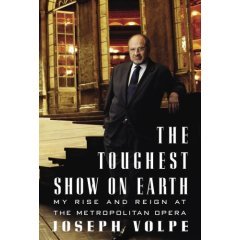
You have to hand it to Joe Volpe. Releasing a memoir of his tenure as head of the Metropolitan Opera could put one in a ticklish situation; doing it before he actually steps down (his last official day is in July) could be construed as downright foolish. Yet if there is one underlying theme that comes out of The Toughest Show on Earth: My Rise and Reign at the Metropolitan Opera, it is the gutsiness necessary with successfully running the nation's largest (and some would say premier) performing arts organization.

Opera exists for conflict, and Volpe's 43-year career at the Met certainly saw its fair share: the struggle to get the new Met house built, the 1980 labor strike that saw part of the season canceled, and, most famously, Volpe's dismissal of soprano Kathleen Battle. Volpe (with co-author Charles Michener) frankly describes the twists and turns of keeping the pressure-cooker that is the Met functioning and even thriving. That Volpe ended up as the head of the company is in itself due to a twist of fate. As a carpenter working on sets for a production of Turandot at the old Met, Volpe wasn't even interested in opera until he happened to hear Birgit Nilsson and Franco Corelli rehearsing the trial scene in Act 2. Hooked, he eventually worked his way up the Met ranks, eventually rising to the rank of general manager in 1990.

Volpe's reign has not been without controversy, and occasionally it seems like Volpe is directly defending himself from his critics, especially when the topics of the administration and management of Lincoln Center arises. Nor do some familiar faces from the Met survive Volpe's critique: snobbish administrators, clueless designers and even long-time music director James Levine get sometimes brutal commentary. Yet Volpe knows where to give credit as well, singling out Levine for the artistic strength of the company, and various board members and donors for keeping the Met afloat through tough financial times.

The Toughest Show is a friendly read for those without a background in music or opera, and contains enough Met history to acclimate the unfamiliar with the company's rich and occasionally stormy history. Those already acquainted with the Met will appreciate the generous use of photos and the chance to understand the lives of the people working behind the gold curtain.