Showing posts with label Memoir. Show all posts

Wednesday, February 28, 2007

Simply magical.

The following excerpt is from Joan Didion's The Year of Magical Thinking:

People who have recently lost someone have a certain look, recognizable maybe only to those who have seen that look on their own faces. I have noticed it on my face and I notice it now on others. The look is one of extreme vulnerability, nakedness, openness. It is the look of someone who walks from the ophthalmologist's office into the bright daylght with dilated eyes, or of someone who wears glasses and is suddenly made to take them off. These people who have lost someone look naked because they think themsleves invisible. I myself felt invisible for a period of time, incorporeal. I seemed to have crossed one of those legendary rivers that divide the living from the dead, entered a place in which I could be seen only by those who were themsleves recently bereaved. I understood for the first time the power in the image of the rivers, the Styx, the Lethe, the cloaked ferryman with his pole. I understood for the first time the meaning in the practice of suttee. Widows did not throw themselves on the burning raft out of grief. The burning raft was instead an accurate representation of the place to which their frief (not their families, not the community, not custom, their grief) had taken them. On the night John died we were thrity-one days short of our fortieth anniversary...
I wanted more than a night of memories and sighs.
I wanted to scream.
I wanted him back.

Rather than risk the possibility of farkeling up a review of this book with my amateurish opinions, I will just say that Didion's memoir of grieving following the death of her husband John Gregory Dunne stayed with me for quite a while after I had finished it. There's been a lot of critiques of the book, especially since it won the National Book Award, and while some may call Didion's prose too removed or cold for a book on grieving, I felt that her tone was that of someone trying genuinely to cope, to rationally think through a process that isn't rational at all. But reading Didion's strong, unique voice, simply contemplating the emotions and memories that accompany the loss of someone so close can be its own comfort. The Year of Magical Thinking does all the things that a good memoir should--deeply honest and beautifully written, it takes us for a brief moment into the mind of its creator.

For more on Didion and her memoir, check out an interview she did with NPR's Terry Gross.

Monday, February 05, 2007

Message in a bottle.


I have to say that I'm impressed with Koren Zailckas. Not so much for the fact that she's written an engrossing memoir while only in her mid-20s, but rather for the fact that she even remembers anything of the period of which she's writing. For much of her teens and early 20s, Zailckas spent much of her time getting drunk, drunk, or recovering from binging. Smashed: Story of a Drunken Girlhood is both the story of Zailckas' struggle with alcohol and a warning of how the dangerous drinking has become a destructive means for young women in particular to overcome feelings of self-doubt and inadequacy.

Zailckas points out early in her book that she was never an alcoholic: she never physically required the buzz from a couple of drinks. A good student from a middle class family, she turned to alcohol beginning at the age of 14 to compensate for her perceived social awkwardness. Stories of increased sexual assult and alcohol poisoning in women often appear in the news, but when Zailckas recounts (or sometimes reconstructs from recollections of more sober friends) her experience having her stomach pumped or memories of relationships that revolved around bar hours, her struggle becomes more personal, or in some cases, familiar. Occassionally Zailckas uses grandiloquent language in describing her drinking, an aspect that I found rather annoying, but when she reins in her language, the reality of her experience comes through strongest.

There are several points at which Zailckas makes attempts to curtail her drinking, but when she falls off the wagon she is frank in pointing out her own poor choices. But she also reveals the pervasiveness of alcohol in society and the often contradictory stances toward what is, at its root, a drug. There's a sense of struggle in Zailckas' writing, that the craving for the courage offered by a drink will be something that may never leave her. Her story isn't likely to leave her readers.

Tuesday, October 10, 2006

Portrait of the author's closet.


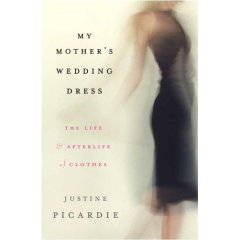
I wasn't sure what I was really expecting when I randomly selected My Mother's Wedding Dress: The Life and Afterlife of Clothes from the new book shelf at the library. A history of famous outfits through history? A tour through fashion trends and revivals?

Well, this is actually a memoir, although a rather inventive one. Justine Picardie, herself a former editor of British Vogue, reflects on her life and family by way of their closets. In doing so, Picardie demonstrates just how much our dress reveals of our selves and sometimes the path our lives take. The wedding dress in the title, a little black dress that Picardie's mother wore only once in spite of its easy elegance, foreshadows the breakdown of her marriage; the hideous pleather trousers Picardie herself sported in the late '70s were as much about teenage rebellion as a fashion statement.

Picardie also goes beyond her own family's history to consider the grip that clothing has on some famous figures. She interviews Donatella Versace, an enigmatic figure in spite of her splashy, bright designs, and gets wound up in the cult of the Brontes while trying to trace the history of a ring. In this sections, it seems like Picardie is trying to flesh out the remainder of her memoir, as she doesn't have quite enough from her own family to make for a complete book. While interesting, it's a little jarring to go from Picardie's own family tale to that of a suicide in a white shirt--there's a connection with the clothes, but it is only by the thinnest of threads. My Mother's Wedding Dress works best as a meditation on what clothes can mean both in life and death, but as a memoir/history it feels incomplete.

Wednesday, August 23, 2006

The portrait of the family.


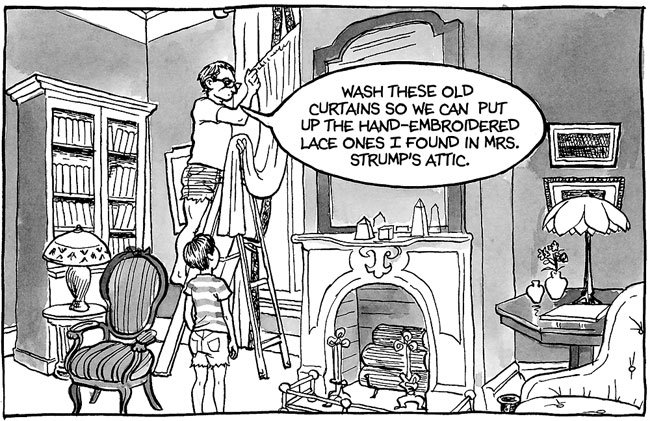
Alison Bechdel's new graphic memoir, Fun Home: A Family Tragicomic, has been getting quite a bit of buzz from various quarters, and with good reason. An engrossing, sensitive narrative, Fun Home has restored my faith in the memoir as quality, worthwhile reading. Often ironic, realistically drawn with bluish-green tinged panels and perfectly paced, Bechdel has created a work that goes beyond the dynamics of her particular family to the more universal theme of a child trying to understand who their parents are and how they have shaped their lives.

The title ironically refers not to the Victorian Gothic revival house that Bechdel's father obsessively restored, but to the funeral home that he ran to supplement his income as an English teacher. At the same time that he's agonizing over William Morris wallpaper, his daughter, Alison, is struggling with her own obsessive behavior in the stultified atmosphere of the house. As Alison reaches adolescence, her growing sense of self and budding sexuality coincides with some revelations about her father's own closeted homosexuality. Gradually, Bechdel's father starts sharing his favorite books with her, leading to a tacit understanding between the two.

Bechdel (creator of the comic strip Dykes To Watch Out For) considers her life while making references to some of the books that her father recommends. Touching on Ulysses, the myth of Icarus and Colette's autobiography Earthly Paradise, it becomes clear that books are the common ground between Bechdel and her father, where they can understand each other.

Bechdel's story works very well in a graphic format, and her images convey tensions more tellingly than paragraphs of prose could. The concluding pages may not ultimately answer Bechdel's questions about who her father was, but the final frames have a closing acceptance and ultimate peacefulness. It's a satisfying end to a work of quiet strength.

Friday, June 09, 2006

And you think you work with divas.

You have to hand it to Joe Volpe. Releasing a memoir of his tenure as head of the Metropolitan Opera could put one in a ticklish situation; doing it before he actually steps down (his last official day is in July) could be construed as downright foolish. Yet if there is one underlying theme that comes out of The Toughest Show on Earth: My Rise and Reign at the Metropolitan Opera, it is the gutsiness necessary with successfully running the nation's largest (and some would say premier) performing arts organization.

Opera exists for conflict, and Volpe's 43-year career at the Met certainly saw its fair share: the struggle to get the new Met house built, the 1980 labor strike that saw part of the season canceled, and, most famously, Volpe's dismissal of soprano Kathleen Battle. Volpe (with co-author Charles Michener) frankly describes the twists and turns of keeping the pressure-cooker that is the Met functioning and even thriving. That Volpe ended up as the head of the company is in itself due to a twist of fate. As a carpenter working on sets for a production of Turandot at the old Met, Volpe wasn't even interested in opera until he happened to hear Birgit Nilsson and Franco Corelli rehearsing the trial scene in Act 2. Hooked, he eventually worked his way up the Met ranks, eventually rising to the rank of general manager in 1990.

Volpe's reign has not been without controversy, and occasionally it seems like Volpe is directly defending himself from his critics, especially when the topics of the administration and management of Lincoln Center arises. Nor do some familiar faces from the Met survive Volpe's critique: snobbish administrators, clueless designers and even long-time music director James Levine get sometimes brutal commentary. Yet Volpe knows where to give credit as well, singling out Levine for the artistic strength of the company, and various board members and donors for keeping the Met afloat through tough financial times.

The Toughest Show is a friendly read for those without a background in music or opera, and contains enough Met history to acclimate the unfamiliar with the company's rich and occasionally stormy history. Those already acquainted with the Met will appreciate the generous use of photos and the chance to understand the lives of the people working behind the gold curtain.