Wednesday, January 31, 2007

Le meurtre dans la ville lumiere.

As of late, I've been drawn to mystery titles published by the Soho Press, a little company that specializes in works set in diverse locales and unusual investigators (just browsing through the library shelves, I've seen crime stories set in Sweden, Afghanistan and the Arctic). Their list includes some well known authors (they publish Peter Lovesey's Peter Diamond series), but some authors are often new to most mystery readers.

One such author is San Francisco-based Cara Black, who sets her main investigator back a decade and on another continent. Aimee Leduc, resident of Ile St. Louis in the center of Paris, makes her living investigating mostly computer crime in the heady early days of the Internet. Yet in Murder in Belleville, Aimee finds herself literally thrown into the search for a murderer after witnessing a car bombing. Roaming far from the well-trod center of the city, Leduc searches the gritty streets of Belleville, a suburb of Paris tense with clashes between Algerian fundamentalists and a government intent on cracking down on illegal immigrants. There's a lot that Leduc has to wade through to get to the truth behind the woman killed in the bombing--and much of it leads to friends of hers and the highest levels of the govenment. Her job is made all the more complicated by shadowy figures intent on keeping her from that truth.

Black creates a multilayered, complex knot of a mystery, fast-paced to the point that it's almost impossible to recall all that's going on. I will admit to be entirely confused by many of the events, some of which tended to assume a strong grounding in the history of Algerian/Franco relations--an area that I'm woefully deficient. But part of the mystery played upon Leduc's relationships with Rene, her brilliant (if mostly off stage) partner, and an Inspector Morbier, whom Leduc seemed to rely on in the past. Murder in Belleville is the second in Black's series (Murder in the Marais is the first), so perhaps anyone interested in Black's P.I. would do best to start with that title. For my tastes, I found Black's frantic pace and sprawling cast of characters a little too confusing. But Black's efforts to provide a different twist to a city that seems so familiar is worth a look for anyone searching for murder in unfamiliar territory.

Friday, January 26, 2007

Travels with chilly.


With so many travel books out on the market, it sometimes hard to capture a reader's interest with yet another story of ramblings about one country or another. So what better way to draw attention to your foray into the genre than by undertaking what any sober person would consider an insane endeavor--an attempt to hitchhike around the whole of Ireland with a refridgerator?

Tony Hawks, to be fair, was not sober at the time he undertook a bet to do just that. Round Ireland With a Fridge is just that--Hawks' month-long journey around the island with a dorm-sized fridge, relying on only the generousity of picking him up off the side of the road in spite of his unusual baggage. Or so the original plan went. Hawks garnered some radio backing, with periodic on-air appeals to give him a lift when rides were slow in coming. I don't know if I would consider that real fulfillment of his bet--nor the use of anything other than a full-size Kelvinator as his traveling companion--but still, it's enough to give Hawks an unusual look at Ireland than if he had been a typical tourist. There's a lot of scenes that happen in pubs and the like (Hawks makes no secret of his desire to enjoy Irish hospitality--preferably with available Irish ladies), but Hawks and fridge also take some forays into some unexpected sidetrips.

Hawks' day job is that of a comedian for a British radio show, and his story is told in a humorous irreverent tone. Following his hilarious description of an especially memorable night in a rural hostel, it's unlikely that I'll ever be able to look at anyone planning a backpacking vacation without feeling pity for them. A twist on travelogues of the past, Hawks' Round Ireland has much of the offbeat feel of Bill Bryson, with the tone of a Dave Barry.

Wednesday, January 17, 2007

A most compelling 'hero.'


I picked up The Talented Mr. Ripley because it was the selection for the sole book club that met at a convenient time for me. So I wasn't really eager to delve into Patricia Highsmith's dark, literary style, which made for slow going in the first portion of the novel. But such detailed characterization leads directly into the mind of Tom Ripley, or as close to an understanding of the motives that drive him to commit his crimes.

The novel opens with Tom posing as an IRS representative, running small con jobs while brooding over his own feelings of deprevation and persecution. When he's enlisted to retrieve a wayward son from Italy, Tom sees his chance to have that life to which he feels entitled. Through manipulation and the use of his incredible talents , Tom sets about to get that life. To say more would be to give away much of the plot, but the story arc is not necessarily the best part of the book. Rather, it's Highsmith's ability to make Tom the sort of person that blurs the distinction between the repulsive and the compelling. Tom is always on the edge of being discovered and all his plans exposed, but much of the suspense lies in whether we want to see Tom come to justice--a question that I doubt would be easily answered. It's a pity that Hitchcock never made The Talented Mr. Ripley into a film (as he did with another of Highsmith's novels, Strangers on a Train), as the atmospheric settings of 1950s Italy would have provided a great backdrop for the suspense of the plot. But Highsmith's carefully crafted work requires no visual interpretation to bring to life her chilling story, and a central character who will likely linger in the minds of anyone who encounters him.

Wednesday, January 03, 2007

The harshest peace.


Being a child of the '80s, my personal perceptions of the Cold War consists of mostly stock images and quotes: duck and cover drills in schools, Spam-stocked bomb shelters, ICBMs paraded through Red Square, JFK's 'Berliner' moment, and always, always the image of a mushroom cloud looming on the horizon.

Of course, the intricacies of the Cold War go well beyond a few points in time. John Lewis Gaddis, professor of history at Yale, has completed several hefty tomes on the subject. Fortunately for those of us who aren't well-versed in diplomatic history, Gaddis has provided an approachable yet thorough introduction to the period in The Cold War: A New History, published in 2005. Writing over a decade after the fall of the USSR, there's never any question in Gaddis' text whose decisions would prove decisive. Gaddis' theories aren't going to break a great deal of new ground: still, even those who are well-versed in the events of the day will appreciate Gaddis' ability to explain clearly the motives of both sides in spite of the tangled geopolitics of the time.

Since The Cold War serves as an introductory text, Gaddis did sacrifice details of events and personalities for the sake of theories and grand strategies. Those looking for a detailed description of the Cuban Missile Crisis or Reagan's words to Gorbachev at Reykjavik won't find either here. But in a war that was just as much about battles that didn't happen, Gaddis' work is indespensible in understanding why events played out as they did.

Monday, December 18, 2006

Nasty weather.


Occasionally I'm struck by a random fascination on a particular topic, and such was the case this past summer when I suddenly felt the need to read something, anything, on tornadoes and storm chasing on the Great Plains. Some cursory catalog searches didn't turn up anything that would satisfy my curiousity, so when I happened to sport Mark Svenvold's account of the May 2004 outbreak of storms on the shelf, I immediately snapped it up.

Tornadoes have always had a fascinating quality about them, driving thrill seekers and scientists alike to drive thousands of miles (literally) in the hopes of seeing just one. Yet the draw of witnessing such storms also speaks to what Svenvold calls 'catastrophilia:' the need to be thisclose to possible, and in some cases, real devestation, either on the ground or beamed over the airwaves via the Weather Channel. It is this fascination with weather as entertainment that makes up the central theme to Big Weather: Chasing Tornadoes in the Heart of America. To be sure, Svenvold does justice to the art of storm chasing, which requires as much luck as science to put a chaser in the right place at the right (wrong?) time. Like any other seemingly insane endeavor, he portrays a case of characters that range from the quiet, Scout master storm spotter, to the main forecaster at the Storm Prediction Center, and the questionable Californian guy who eventually gets to do some 'real' science out of his homemade tornado intercept vehicle.

These parts of Svenvold's work clip along well, but he's as much concerned with the effect global warming and the Weather Channel have had on the weather and how we perceive it. Although Svenvold makes the argument that both have made impacts on the storms over the plains, the momentum Svenvold had created in the remainder of the work effectively lapses into doldrums. To make the entire book a description of his jaunts across Middle America would be bowing to the lure of catastrophilia, but while struggling through his meditation on the sublime as it relates to storms, I wonder if some more stringent editing could have been merited. Still, Svenvold covers the complete culture of storm chasing in a manner that few other authors have done.

Tuesday, December 12, 2006

A short work about a long walk.


In this era of fitness mania and extreme sports, the idea of someone walking across the entire North American continent still elicites a sense of awe. We are, after all, talking 3,500 miles across rugged mountains and sweltering plains. Even with modern conveniences such as cell phones and survival gear, it still remains a daunting undertaking. Crossing the continent over a hundred years ago with nothing but a couple of revolvers and five dollars in hand was considered grounds for insanity. Still, that is exactly what Helga Estby and her eldest daughter Clara undertook in the spring of 1896, setting out from their rural Norwegian settlement near Spokane, Washington to New York City, in an attempt to win a $10,000 wager from an anonymous figure. The walk was an epic undertaking, but as Linda Lawrence Hunt chronicles in Bold Spirit: Helga Estby's Forgotten Walk Across Victorian America, it was only a small part of the shifts in the political and social landscapes of America at the cusp of a new century.

Like other studies in microhistory, Hunt uses the experience of one, nearly forgotten individual to cast light on the larger shifts within history. The benefit is to make history personal, which is Bold Spirit's strongest point. Estby was a strong, determined woman whose cross-country trek was likely the least of the hardships that she faced in her lifetime. However, getting into the mind of someone nearly 70 years dead is nearly impossible, and Hunt's task is made all the more difficult by the fact that all of Estby's manuscripts recounting her trip were destroyed by her children in the 1940s. This bit of cultural vandalism was a direct consequence of Helga's walk, and makes Hunt's points about the importance of preserving family histories. But it also leaves Hunt with little to go on other than interviews with Estby's granddaughter and scattered newspaper accounts of the trek itself. These hint at Estby's feelings regarding women's rights, the contentious election of 1896 and the cultural mores of Norwegian immigrants in America, among many other topics , but Hunt's attempts to flesh out the whole story comes down to a lot of conjecture. And, more tragically, there's little chance to hear Helga's story in her own words. Still, Hunt's rediscovery of Estby's remarkable endeavor makes for an unique perspective about a pivotal point in history and introduces modern readers to a woman who was well ahead of her time, even if her full story will forever be lost to time.

Friday, October 13, 2006

Red herrings, anyone?


I've decided to take a brief break from my typical interest in cozy mysteries to try something a little different. I've never read much in the way of police procedurals, but after coming across Peter Lovesey's Diamond Dust, I thought I would give the subgenre another try.

Part of Lovesey's series surrounding Detective Inspector Peter Diamond, Diamond Dust picks up with Diamond at a sort of ebb in his career. Wrapped up in fighting a possible demotion, he thinks nothing of stopping by a recently discovered murder near Bath's Royal Crescent--only to be stunned to find the victim is his own wife. Diamond quickly embarks on an investigation to locate her killer, but a police force leery of a grieving husband commanding an investigation quickly relegates Diamond to a desk job. Frustrated and under suspicion, he begins his own parallel search into his wife's past, only to realize that his someone from own past might know more than they let on.

That's the main premise of the story, at least. I had never read anything by Lovesey before, a longtime writer who has won pretty much every award in the mystery genre. That he deserves the accolades is apparent in the bewildering array of blind alleys, false leads and subplots that keep Diamond (and the reader) throughly at a loss as to who the culprit is. There's a lot of shifty intrigue going on here, and the fact that Lovesey can keep a grip on the plot thread while still propelling the mystery forward is remarkable. But this fast and convoluted plot comes at the sacrifice of character development. Diamond is portrayed as a hard-nosed, tough veteran who isn't really meant to be likeable, but this doesn't explain why I had little sense of him as a character. Understandably, the other players are lightly sketched, but more on Diamond's wife would have made her less a bloodied body and more of a human being, and lent some humanity to her grieving husband. If Lovesey's characters were as complex as the tightly knotted mysteries he creates, there would be little to find fault with his novels.

Tuesday, October 10, 2006

Portrait of the author's closet.


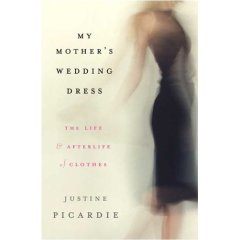
I wasn't sure what I was really expecting when I randomly selected My Mother's Wedding Dress: The Life and Afterlife of Clothes from the new book shelf at the library. A history of famous outfits through history? A tour through fashion trends and revivals?

Well, this is actually a memoir, although a rather inventive one. Justine Picardie, herself a former editor of British Vogue, reflects on her life and family by way of their closets. In doing so, Picardie demonstrates just how much our dress reveals of our selves and sometimes the path our lives take. The wedding dress in the title, a little black dress that Picardie's mother wore only once in spite of its easy elegance, foreshadows the breakdown of her marriage; the hideous pleather trousers Picardie herself sported in the late '70s were as much about teenage rebellion as a fashion statement.

Picardie also goes beyond her own family's history to consider the grip that clothing has on some famous figures. She interviews Donatella Versace, an enigmatic figure in spite of her splashy, bright designs, and gets wound up in the cult of the Brontes while trying to trace the history of a ring. In this sections, it seems like Picardie is trying to flesh out the remainder of her memoir, as she doesn't have quite enough from her own family to make for a complete book. While interesting, it's a little jarring to go from Picardie's own family tale to that of a suicide in a white shirt--there's a connection with the clothes, but it is only by the thinnest of threads. My Mother's Wedding Dress works best as a meditation on what clothes can mean both in life and death, but as a memoir/history it feels incomplete.

Thursday, October 05, 2006

Politics, with all the promise and frustration.


First: I did not pick up a copy of Robert Penn Warren's novel All the King's Men with the intention of seeing the movie afterwards. I've been getting a kick out of reading the generalized pans, but that's the extent of my interest in the film. I actually decided to read Warren's novel for two other reasons: it's election season, and a book that's been called 'the American novel of politics' seemed an appropriate read, and second, I wanted to see how well the Pulitizer Prize-winning tome held up 60 years after its publication.

All the King's Men is about politics, and has all the traits of politics: alternatively frustrating, inspiring, long-winded and rousing, Warren's novel seeks to set its stamp on American life, in this case literature, rather than history. Loosely following the story of 1930s Louisiana populist Huey Long, Warren creates a Greek tragedy nominally centered on Willie Stark. Like Long, Stark is portrayed as a man of the people who rises to office pledging to fight the rampant system of graft and entitlement, only to fall short of his own high morals. But really, All the King's Men is the story of Jack Burden, a man who is best described as an 'operator' in the Stark administration, digging up dirt on political opponents so Stark can get his way. When he's directed to dig into the history of one of his closest friends, Burden uncovers a history of lies that eventually is disasterous for Stark and those around him.

Warren was once the poet laureate for the nation, and his description of the Louisiana's steamy natural and political environments can be seen as evocative and transporting for the first few hundred pages, after which it just gets downright oppressive. The characters of Stark and Burden are well drawn, but many of the supporting characters (especially the women), just seemed somehow unbelievable. Much like Greek tragedy, Warren demands quite the suspension of disbelief, but to do so for 600 pages of text seemed like asking a lot. Parts of the novel hold flashes of brilliance--Warren can build tension better than many mystery writers--but the frustrations of the rest of the novel makes All the King's Men ironically very true to its political basis: so much promise, but lacking in execution.

Tuesday, October 03, 2006

British murder spree! part 3


I've always had something of an ambivalent attitude towards Agatha Christie's oeuvre. Yes, she essentially created the modern British mystery genre, but at the same time her most famous of sleuths (Miss Marple and Hercule Poirot) can be seen as something of cliches. But putting aside such misconceptions, Christie's work still stands as landmarks in the genre. And although the Poirot and Marple novels are her best known works, she did write a considerable number of mysteries that didn't feature either detective.

I came to The Sittaford Mystery (also published as The Murder at Hazelmoor) after seeing the film version recently produced by PBS. I'm glad I decided to read the book: save the names of the characters and the setting (a village in England's west country), the plot is almost entirely different and much more satisfactory, in my opinion. The story starts out simply enough: snowbound and bored, some villagers conduct a seance, where it is revealed that the wealthiest resident of the village is dead. Alarmed, his best friend sets out across the snow to check on him, arriving to find him blugeoned to death. A ner'do-well nephew set to inherit the estate is arrested, and the case appears closed. But then that nephew's fiancee Emily appears, determined to release her hapless future husband and find the real culprit.

It's too bad that Christie didn't write more mysteries with Emily Trefusis as the main detective, as Emily's mix of independence, vivaciousness and dogged persistence would have made for an interesting series. With the help of a somewhat unscrupulous journalist, Emily learns enough of the villagers' secrets to find the real murderer. Christie's murders may not be entirely suspenseful (how, exactly, does someone die from being slugged by a sandbag?) but tightly wound plots and a solution that requires careful deduction on the part of her detectives makes Christie's mysteries still appealing even after 70 years in print.

Wednesday, September 27, 2006

British murder spree! part 2


Like Laurie R. King's Mary Russell novels, time and place are central to Elizabeth Peters' novels featuring Amelia Peabody. Like Russell, Peabody is fiercely independent and confident in her abilities, in spite of having spent much of her life under the thumb of her domineering father in 1880s Victorian England. In Crocodile on the Sandbank, Peabody immediately sets out for Egypt, determined to see more of the world after her father's death. Immediately at home in the Valley of the Kings, Peabody sets to work 'assisting' Egyptologist and bachelor Radcliff Emerson, much to his displeasure. Their work is soon interrupted by the appearance of a mummy that drives away all the Egyptian workers and threatens the lives of Peabody and her companions. I found the mystery to be a little hokey (the rampaging mummy kept bringing to mind the Brendan Fraser film The Mummy) and an annoying damsel in distress that everyone would probably be better off without. But Peabody herself is a plucky, appealing character, and her battles with Emerson are enjoyable to behold, even if you already know who's going to come out victorious.

It's not surprising that Peters also did quite a bit of work in romance fiction, as the strength of her book lies not in the mystery (which is quite easy to figure out), but in the sparks between her characters. Originally published way back in the 1970s, Crocodile is the first of Peters' long Peabody series, all set in colonial Egypt. The exotic time and place of the series is also one of its draws, and the fast moving plot and romantic undertones makes Peters' detective an appealing read.

Monday, September 25, 2006

British murder spree! part 1


Okay, so this post's title is a rather devious attempt to make this post seem more lurid than it actually is. True, I've been indulging in my taste for British murder mysteries, so there are quite a few bodies turning up, but to term it a spree is a bit of a misnomer. Yes, it's murder, but this is civilized killing, thank you. So put on your tweeds, make some tea and curl up while these people go about nicely dispatching each other.

I had previously written about Laurie R. King's The Beekeeper's Apprentice featuring Sherlock Holmes and Mary Russell, enjoying King's creation of a feisty, liberal partner to Holmes' Edwardian coolness. Continuing with A Monstrous Regiment of Women, King focuses more on developing Russell's character, as Mary delves into the inner workings of a women's organization in which various members have been dying suspicious deaths. Holmes is mostly offstage during the investigation, but never far from Russell's mind as she finds the detective playing a larger role in her life. I've read a few more of King's series, and her strongest abilities lie in the interplay between Holmes and Russell, similar to that of Sayers' Wimsey/Vane novels, and her depiction of post World War I Britian. As her series moves along, I found King's plots to be more tangled, something that wasn't as much the case in the earlier books, were the emphasis was more on suspense rather than unraveling the mystery.

More bodies to come...

Friday, September 22, 2006

I really should be less cynical about book reviews.

Everyone is in love with Frank Portman. Every review that I've come across for Portman's first novel, King Dork, has been in raptures about Portman's take on high school life since it first appeared earlier this year. So of course, I'm immediately skeptical, as usually happens when something appears to be too good to be true, especially in the case of young adult lit, which more often than not can have adults swooning and teens passing.

King Dork meets this challenge head on, poking fun at that Holy Grail of teen lit, The Catcher in the Rye, turning its subject of teen angst on its head. The anti-Holden Caulfield here is Tom Henderson, a mostly rational and thoughtful human being who has the misfortune of attending high school with a bunch of psychotic normal people. As such, Tom (or Chi-Mo or King Dork), spends most of his time trying to avoid abject humiliation from students and staff alike, while attempting to set up a rock band with his friend-in-the-alphabet, Sam Hellerman. When Tom stumbles upon some of his dead father's books, it opens up a mystery surrounded by codes, fake people, questionable pronounciation and what really happened to his father during his high school years. There's no way that I can really do justice to the whole arc of the plot, only to say that I laughed out loud at many of Portman's perceptions of high school. His depiction of Tom's equally clueless ex-Hippie parents is hilarious, a sly commentary on how adults want to perceive their teen children, and just how much teens can see through such b.s. The only complaint I have is that such a twisted storyline takes its time building up, but Tom's such a good observer that those sticking with him will be well rewarded by the conclusion.

Portman, himself a member of the rock group the Mr. T Experience, laces King Dork with references to various rock groups, completes the book with a glossary of terms and misprounciations from the book, and a list of the devil's head incarnations that Tom's band goes through. There's some sex, which might put King Dork at risk for challenge, but if it is it would work to the book's favor in getting it more attention. Not that getting teens to read it should be difficult. I liked VOYA's little blurbette: "King Dork...will appeal only to...teens with an interest in...oral sex..."

Well, who am I to argue with that?

Tuesday, September 19, 2006

Manga meets meditation.


I do not claim to know anything about Buddhism, graphic novels or, for that matter, formatting photos in Blogger (my apologies for the above arrangement), but that did not keep me from pushing through all eight volumes of Osamu Tezuka's imaginative and epic retelling of the life of Siddhartha. And I do mean epic: ranging across the foothills of the Himalayas thousands of years ago, Buddha has a huge cast of characters and enough raging battles, miracles and doomed love affairs to make any Charleton Heston flick pale in comparison. This isn't an accident; Tezuka takes definite liberties with the historical record, creating characters and events that help to define his vision of Siddhartha's journey to enlightenment, with a great deal of pulpy action and adventure thrown in. The result is a mostly fast-paced, sometimes irreverent romp through ancient northern India, as Siddhartha slowly becomes Buddha and develops his insights that would become the religion of Buddhism.

Handsomely published in the U.S. by Vertical, the real star of Buddha isn't the story, but Tezuka's vibrant artwork. Best known for his Astro Boy series, Tezuka's take on Buddha is sort of manga for adults--but with all the same visual appeal as his more popular work. The settings allow for some beautiful and suprisingly detailed panoramas, and the violence is simply but effectively portrayed in a spray of ink. Probably the most effective aspect as I read along was Tezuka's ability to depict the emotions of his characters: a devious look instantly establishes a character's untrustworthy nature, and the full impact of Siddharta's inner struggle is telegraphed over his features.

That the visual is so well done works well in Tezuka's favor, as the weakest point about Buddha is the sometimes painful dialog. Do not expect great monologues to complement the great art. But the dialog does have the benefit of making each volume a pretty fast read (each averaging around 350 pages, a volume can be finished off, at most, in a few hours). Other quibbles: the height of the story, I felt, came in the middle of the set (v. 3-5), with the story tending to drop off a bit in the concluding installments. And given how much of Buddha is imagined, it was rather disappointing to see most female characters relegated to passive slaves or victimized royalty. As an introduction to the work of Tezuka, Buddha might not be representative, but it does mark an interesting blend of the serious with a popular art form gaining in respect.

Friday, September 15, 2006

After the levees broke.


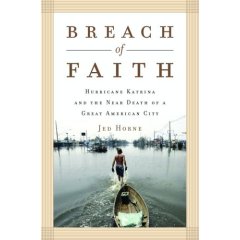
Like most Americans, I was sickened by what I saw happening in the aftermath of Hurricane Katrina. After the images of suffering in the Superdome, and bodies left to rot in the streets of New Orleans, it was hard to imagine it getting any worse. As the storm surge subsided, a flood of books has appeared, attempting to explain just what transpired in late August 2005. Among the hefty (The Great Deluge by Douglas Brinkley), the scientific (The Storm by Ivor van Heerden and Mike Bryan) and the official (A Failure of Initiative by the select committee appointed by the House of Representatives), I went with Breach of Faith: Hurricane Katrina and the Near Death of a Great American City by Jed Horne. Metro editor of the Times-Picayune, Horne is well-versed in New Orleans' culture and politics, elements just as important to the course of disaster as weather reports and evacuation plans.

Mixing personal accounts with commentary, Horne creates a vivid portrait of a city ill-served by its elected officials well prior to 2005, and fully documents the continuing failures after the storm. Harshest criticism is reserved, of course, for the inept bungling by FEMA and the Bush Administration, but the Army Corps of Engineers, mayor Ray Nagin and the Orleans levee board each receive damning evidence of misplaced priorities or downright fraud. Horne also dispels many of the misconceptions created by the media, calling into doubt the images of rampaging gangs bent on looting any and all stores, and the supposed lawlessness at the Superdome and Convention Center.

This isn't a book to read if you want something calming--I often found myself wanting to throw it through a wall in frustration at the ineptitude of those in charge. But Horne also includes stories of perserverance--the ordeal of Patrina Peters, who survived on the roof of her flooded home during the storm, heroic efforts at isolated hospitals, the grassroots effort Common Ground which stepped in when the Army and the aid organizations refused. Most of the second half of the book is an examination of the efforts to determine which direction the new New Orleans needs to go. This part lags a bit in terms of storytelling, but represents the more important questions resulting from Katrina: is it right to allow people to rebuild New Orleans as it once was, even when the previous chapters revealed a city seriously in need of reform and overhaul? Horne makes the case for a new city, but for New Orleans to rise again, the events recounted in Breach of Faith demonstrate that it will be a long, drawn out prospect, requiring much more than staunching holes in the levees.

Tuesday, September 12, 2006

On the trail of Revolutions.


When it first appeared in print over 500 years ago, Nicolaus Copericus' magnum opus De revolutionibus orbium coelestium libri sex (On the Revolution of the Heavenly Spheres) revolutionized the budding science of astronomy. Its publication in 1543 was the death knell for the thousand-year old notions of Ptolemy's Earth centered universe, heralding the dawn of a new, empirical method of doing science. Or did it?

Challenged by a historian's claim that no one read the watershed book when it was first published, Harvard astronomer and historian Owen Gingerich went to epic lengths to track the impact De revolutionibus had on scientists of the sixteenth century. To do so, he undertakes the task of locating and examining as many first and second editions of the work all over the world. Conducting a book census sounds about as interesting as watching a bookworm chew through a dusty tome, but in The Book Nobody Read: Chasing the Revolutions of Nicolaus Copernicus, Gingerich finds that a seemingly straightforward task can lead into unknown corners of historical record and the modern book trade.

Gingerich discovers richly annotated copies of De revolutionibus that quickly settle the question of whether the book was read when it was first published, but raise other issues. What impact did the Catholic church's censorship of De revolutionibus have on the book's readership? Who bought the expensive book and why? How did scientists spread across Europe communicate with each other over the ideas in the book? The questions are not limited to issues of the fifteenth century: Gingerich finds himself testifying in court over a missing De revolutionibus, puzzling over rebound and fake copies, and navigating hostile Soviet bureacracy to reach copies behind the Iron Curtain.

Weaving astronomical history in with the pursuit of rare copies, Gingerich's volume is as likely to appeal to bibliophiles as to astronomy buffs. For those not entirely familiar with such history, parts of Gingerich might be hard to follow--many names sound similar and some are almost entirely obscure. Perhaps a brief collection of biographical sections at the end of the book would make it more approachable, but as it is, Gingerich simply includes notes and an abbreviated version of his final census. For the casual reader, perhaps something like Timothy Ferris' Coming of Age in the Milky Way would offer a better introduction to astronomy history. In terms of sheer persistence and bibliographic sleuthing, Gingerich's chase of Copericus' revolutionary book is a worthy example.

Saturday, September 09, 2006

What rhymes with Bush?

In spite of my best efforts, I’m not the sort of person who would just willingly sit down with a volume of poetry. Nor am I one to spend precocious reading time with any political diatribes masquerading as rational thought. So why exactly did I pick up Calvin Trillin’s new volume A Heckuva Job: More of the Bush Administration in Rhyme? Well, in part due to Trillin’s recent appearance on The Daily Show and previous familiarity with some of Trillin’s essays, but mostly in an attempt to feebly laugh at what has become a scary situation.

As poetry, Trillin is more Ogden Nash than Byron, but his limerick-style is suited to the nonsensical subject matter. Redundant sounds and forced rhythms make A Heckuva Job downright annoying to read straight through, but Trillin isn’t interested so much in proper placement of stresses as he is in driving home his political barbs. This he does with a wry tone, covering the misadventures of Iraq , the war on terror, and the sluggish Katrina response. A stanza from The War in Nine Stanzas is indicative:

Though nothing showed Iraq had played a part,
That’s where some hawks thought vengeance ought to start.
(Then terrorists could count on what we’d do:
Attack us, we’ll strike back, though not at you.)
We toppled first that band of Afghan loonies
Who’d let bin Laden hide out in their boonies.
The Taliban were smashed in one fell swoop.
Bin Laden, though, had plainly flown the coop.
Bush then forgot that name, and said, “In fact,
Iraq’s the place that has to be attacked.”
The war, Rove thought, with this one course correction,
Could still endure until the next election.
(August 15, 2004)

The types and subjects of the attacks are nothing new, and over the course of the volume, Trillin tends to repeat himself. As any good roast needs to be, though, each poem in A Heckuva Job contains enough truth to hit home. In the case of Dubya's policies, that might mean more of an occassion to cry, but at least Trillin's poesies add a little bit of comic relief.

Tuesday, September 05, 2006

A scientific dispute for the ages.


As a graduate who has earned a degree in the humanities, I tend to regard those in the sciences as having a considerably easier task in tracking down what is real in nature: formulate the hypothesis, test it and if it works, everyone basically agrees that's the way things are. Yet, as the recent brouhaha over the status of Pluto has demonstrated, there can be a surprising amount of decisions that scientists have to make.

Before there was Pluto, there was the issue of what happens to a star in the course of its lifetime. In the early twentieth century, the debate over what the scientific evidence disclosed and what theories raged in astrophysical circles, easily making or unmaking academic careers. On the one side was Sir Arthur Eddington, world-renowned scientist, theorist and practically credited with inventing astrophysics. On the other was a young unknown Indian scientist, Subrahmanyan Chandrasekhar, who formulated the almost unfathomable notion of black holes. Their despute, and the repercussions that it had on the course of astronomy and physics, is the subject of Arthur I. Miller's Empire of the Stars: Obsession, Friendship, and Betrayal in the Quest for Black Holes. Following Chandra, Eddington and their contemporaries through blind alleys, dead ends and false leads, Miller weaves the tale of how the quest to understand the life of the stars nearly cost both scientists their reputations. Only with the advent of the atomic bomb and achievements in observational methods did Chandra's efforts be recognized, and black holes become a physical reality.

Part biography of Chandra, part history of an idea, Miller draws on a trove of sources, especially Chandra's own revealing personal letters. He also traces the many competing theories concerning the lives of stars, taking the story well beyond just Chandra and Eddington. Miller includes considerable back matter, including a glossary, brief biographical sketches, notes and appendices, but for those who may not have a comfortable gasp on basic physical and chemical principals may find Empire to be a bit of a challenge. I personally found the latter portion of the book, which dealt with the observational findings and the development of the atomic bomb to be more interesting. Empire of the Stars probably isn't for everyone, but because of Miller's thorough research, could be quite important to anyone interested in the history of science.

Thursday, August 31, 2006

Parallel universe.

Pity poor Misha Vainberg. All he wants to do is escape from St. Leninsgrad to return to that mecca of hip hop, New York City, with his South Bronx sweetheart Rouenna. But just because his father (the 1,238th richest man in Russia and renowned for selling an 800 kilogram screw to KGR) happened to off a politically connected Oklahoman, the generals in charge of the INS won't give Misha a visa. And now, when his beloved Rouenna writes from Hunter College (where she is majoring in secretarial skills) that she is carrying on with Jerry Shteynfarb (author of The Russian Arriviste's Hand Job), Misha is desparate enough to head to the oil saturated state of Absurdistan, where a crooked Belgian immigration official has a passport ready for a small fee.

Before the greasy official can hand over Misha's ticket to the Bronx, war breaks out between the Sevo and Svani ethnic groups over the topic of Christ's footrest, and KBR (a subsidiary of Halliburton) quietly sneaks into the country with a sweet deal from the Department of Defense. Soon, Misha finds himself as appointed head of the Office of Multiculturalism in the mostly corrupt government, and it only gets weirder from there. Absurdistan, by Gary Shteyngart (author of The Russian Debutante's Handbook) is a dark comedy that has no limit to the absurdities Misha goes through, each with a biting element of the current state of affairs to it. Sporting a Candide-like sense of optimism through it all (or maybe it's the Adivan), Misha somehow holds on to his sense of purpose, even as missles are being launched from the roof of the Park Hyatt.

Shteyngart has a bitter, ironic tone throughout the book, excepting Misha, who blithely sails through the chaos around him with a minimum of qualms. I had a bit of trouble getting into the book, partly because it moves very quickly. Once Misha arrives in Absurdistan though, the plotting works better as the whirlwind of corruption picks up steam. Touching on the insane policies of yesterday (the Cold War) and today (the war on terror), with the backdrop of American consumerism and Russian fatalism, Absurdistan closes as something of a bad dream for Misha. Freed from the country, he sets out to join Rouenna in the Bronx. The date? September 11, 2001.

Wednesday, August 23, 2006

The portrait of the family.


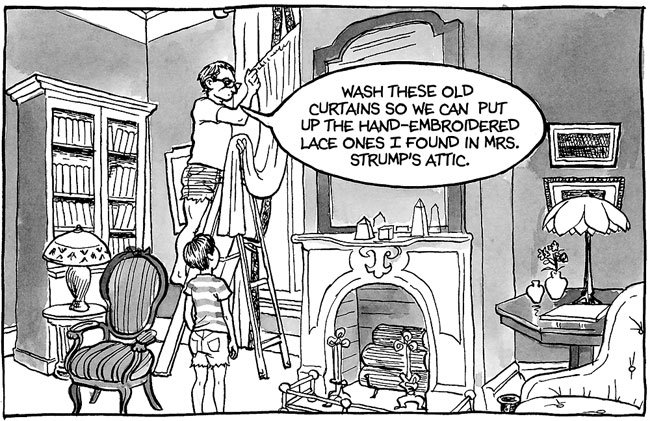
Alison Bechdel's new graphic memoir, Fun Home: A Family Tragicomic, has been getting quite a bit of buzz from various quarters, and with good reason. An engrossing, sensitive narrative, Fun Home has restored my faith in the memoir as quality, worthwhile reading. Often ironic, realistically drawn with bluish-green tinged panels and perfectly paced, Bechdel has created a work that goes beyond the dynamics of her particular family to the more universal theme of a child trying to understand who their parents are and how they have shaped their lives.

The title ironically refers not to the Victorian Gothic revival house that Bechdel's father obsessively restored, but to the funeral home that he ran to supplement his income as an English teacher. At the same time that he's agonizing over William Morris wallpaper, his daughter, Alison, is struggling with her own obsessive behavior in the stultified atmosphere of the house. As Alison reaches adolescence, her growing sense of self and budding sexuality coincides with some revelations about her father's own closeted homosexuality. Gradually, Bechdel's father starts sharing his favorite books with her, leading to a tacit understanding between the two.

Bechdel (creator of the comic strip Dykes To Watch Out For) considers her life while making references to some of the books that her father recommends. Touching on Ulysses, the myth of Icarus and Colette's autobiography Earthly Paradise, it becomes clear that books are the common ground between Bechdel and her father, where they can understand each other.

Bechdel's story works very well in a graphic format, and her images convey tensions more tellingly than paragraphs of prose could. The concluding pages may not ultimately answer Bechdel's questions about who her father was, but the final frames have a closing acceptance and ultimate peacefulness. It's a satisfying end to a work of quiet strength.