Wednesday, August 23, 2006

The portrait of the family.


Alison Bechdel's new graphic memoir, Fun Home: A Family Tragicomic, has been getting quite a bit of buzz from various quarters, and with good reason. An engrossing, sensitive narrative, Fun Home has restored my faith in the memoir as quality, worthwhile reading. Often ironic, realistically drawn with bluish-green tinged panels and perfectly paced, Bechdel has created a work that goes beyond the dynamics of her particular family to the more universal theme of a child trying to understand who their parents are and how they have shaped their lives.

The title ironically refers not to the Victorian Gothic revival house that Bechdel's father obsessively restored, but to the funeral home that he ran to supplement his income as an English teacher. At the same time that he's agonizing over William Morris wallpaper, his daughter, Alison, is struggling with her own obsessive behavior in the stultified atmosphere of the house. As Alison reaches adolescence, her growing sense of self and budding sexuality coincides with some revelations about her father's own closeted homosexuality. Gradually, Bechdel's father starts sharing his favorite books with her, leading to a tacit understanding between the two.
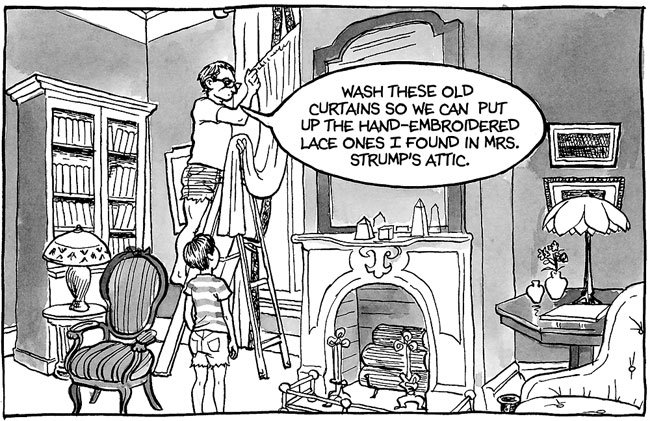
Bechdel (creator of the comic strip Dykes To Watch Out For) considers her life while making references to some of the books that her father recommends. Touching on Ulysses, the myth of Icarus and Colette's autobiography Earthly Paradise, it becomes clear that books are the common ground between Bechdel and her father, where they can understand each other.

Bechdel's story works very well in a graphic format, and her images convey tensions more tellingly than paragraphs of prose could. The concluding pages may not ultimately answer Bechdel's questions about who her father was, but the final frames have a closing acceptance and ultimate peacefulness. It's a satisfying end to a work of quiet strength.

Wednesday, August 16, 2006

"Dammit Holmes! It is not elementary!"


It’s a risky proposition for an author to resurrect an iconic literary character for the purpose of a new series; even more questionable is the addition of a sidekick for the famous figure’s comeback. In the world of mystery fiction, no figure is more sacred than Sherlock Holmes. Yet Holmes’ stature has not kept Edgar-awarding winning author Laurie R. King from imagining what the detective would be like had he happened to take a precocious fifteen-year-old girl under his wing and teach her his craft.

Dangerous, yes, but in creating Mary Russell, the apprentice to Holmes' beekeeper in The Beekeeper's Apprentice; or, On the Segregation of the Queen, King has given Holmes a formidable ally. Fiercely intelligent, the staunchly feminist Russell is the perfect match for the idiosyncratic and often misogynist detective. Through tests of increasing difficulty, the two slowly gain each others trust. But just as Russell and Holmes have become a team of considerable prowess, an opponent from Holmes’ past reappears, with nothing less than the destruction of Holmes and all those near to him their only desire.

I haven’t read any of the original Holmes stories, so I can’t say whether King matches Sir Arthur Conan Doyle in terms of literary merit. But King has created an engrossing chess match of a mystery that requires the full concentration of both detectives and the reader. Her depiction of World War I era England is vivid, and the dawning of women's rights coupled with the passing of the Edwardian era creates a tension in the plot. My quibbles are minor: the story occasionally flags as King goes about constructing her plot and characters, and the beginning is entirely too hokey. Since completing The Beekeeper’s Apprentice, King has penned seven more Russell/Holmes titles, and has developed quite a following in the process. It’s an impressive start, and the rest of the series promises to be just as intriguing. Book number two (A Monstrous Regiment of Women) is already on my request list.

Monday, August 14, 2006

It's just a phase.


Ah, those glorious teenage years, full of self-discovery, intellectual stimulation, and the quest to become a well rounded individual. Or at least that’s the plan. The reality is usually more embarrassing and awkward, especially if your best friend turns out to be an ‘enthusiast,’ as Julie Lefkowitz knows all too well. When Ashleigh’s obsession with King Arthur leads to a pots-and-pans coat of armor, or her craze for a local band has them camped out under wet blankets, Julie stoically goes along. But when Ashleigh’s attentions shift to Jane Austen, Julie fears what her friend’s whole hearted enthusiasm will do to her favorite author.

Plenty, as Polly Shulman’s first novel Enthusiasm shows. Drawing on her love for Pride and Prejudice, Ashleigh convinces Julie to crash a local boys prep school to search for her own version of Mr. Darcy. The man is found, in the form of Grandison Parr, and the girls conspire to join the school’s musical in order to be near him and his best friend. But trouble arises when Julie learns that Ashleigh has mistakenly assumed Julie likes Parr’s friend—and has a crush on Parr herself.

Shulman’s effort doesn’t stray too far from formula (a school musical, readings in Romeo and Juliet, the obligatory bad boy, divorced parents), and the Austen twist peters out as quickly as the girls’ interest in the minuet. Still, for typical teen formula, Shulman does okay, creating sympathetic teen characters that have a fair amount of depth to them. Enthusiasm might be stronger had it ventured further into the Austen theme, picked up on some the themes of Austen's novel or had a stronger conflict, but on the whole it remains a pleasant if not especially memorable read.

Wednesday, August 09, 2006

Who wants to be like Kate?


There are some books that appear on bookseller and library shelves that really just beg the question: What is the point? Various 'gift' books, anything by Mitch Albom, most books penned by celebrities and the style advice book, generally fall into this catagory. Today's book, Style by Kate Spade, can claim two of these characteristics: Spade, the creator of a pricey line of home accessories, stationary, bags, etc. under the ingenious name kate spade, dispenses pithy advice to the stylistically clueless. As a long time member of this group, I thought perhaps Kate might be able to lead me to enlightenment. Alas, not to be: shelve this one firmly in the pointless aisle.

Perhaps I shouldn't be so hard on Ms. Spade, as writing about style for a book is a tricky proposition. An author is generally left to rehashing little bits of common style knowledge, while reiterating that 'style is a personal expression.' That's pretty much what happens here, but Spade chooses to fill out some of the remaining white space with her personal style favorites: for example, Kate likes to pair her blues with tangerine, watermelon or taupe, and she considers Barbarella to be a good example of 'style in space.' We also get a watercolor rendering of Mr. Kate Spade's favorite ski hat (a Swix brand blue Nordic knit with a tassel, if you were curious). Fascinating stuff for the Spade fans, but for the rest of us, it doesn't provide a great deal of guidance.

The illustrations provided are watercolors by artist Virginia Johnson. Charming as art, they aren't very useful as guides, and the sporadic instances where they're used makes them even less so. I found the final two sections of the book on the types and maintenance of clothing articles to be somewhat useful, but again, similiar information could be found elsewhere in probably more complete form. Style is one of three books in a series created by Spade (Manners and Occasions being the others), and while one isn't likely to commit a horrendous faux pas following her advice, there's also little chance of breaking new ground either. True style mavens will already know many of the ideas Spade suggests, and others may do just as well browsing fashion magazines or reading up on stylish women of the past.

Sunday, August 06, 2006

On the beach (Miami, that is).


Summer is the most forgiving season: you can wander about outdoors barefoot, drink another beer safe in the knowledge you'll simply sweat out the alcohol, and indulge in reading equally lasting in nature. Alisa Valdes-Rodriguez's latest novel, Make Him Look Good, is a prime example of the summer read, light in substance and not terribly trying on the mind.

Valdes-Rodriguqez's novel, fittingly, takes place in and around Miami Beach, a locale not known for its substantive culture. The plot revolves around the 'him' of the title, Latin pop sensation Ricky Biscayne and the women in his life: Milan, the deeply enamored secretary of the Las Ricky Chickies fan club; Jasminka, Ricky's Serbian supermodel wife; Irene, the firefighter who has good reason to hate Ricky's guts, and Jill Sanchez, a very poorly disguised caricature of a particular pop star, among others. However, the task of making Ricky look good is increasingly difficult, until Ricky finally gets the ending that he deserves.

Valdes-Rodriguez moves the narrative between different characters in the plot, sometimes in first person, sometimes in third, which can lead to some confusion over just who's talking when. It also leads to some rather laughable point-of-view choices--I had a hard time buying the supernatural powers of a particular cat. Valdes-Rodriguez also struggles somewhat with her characterization. Along with the Sanchez character (which, to be fair, could be passed off as satire), few characters really achieve any sort of depth, especially the men. This in turn plays into a predictable plot, an unfortunate tendency of one character to lapse into valley-girl speak...

Still, I did chuckle at a few of Valdes-Rodriguez's plot twists, and her portrayal of the insanity that is the pop music industry provides some biting satire. Overlooking the flaws, Make Him Look Good might satisfy some beach readers--there are plenty of plot turns, even if you can see them coming a mile off. The novel's strongest aspect is the vivid recreation of Miami's diverse culture, especially that of its Cuban and Latino populations. For those looking for an easygoing beach read, Make Him Look Good provides suitable effervescent entertainment; those seeking something a bit more substantive might wish to pass.

Thursday, August 03, 2006

Camara, check. Road map, check. Revolver and political vendetta, check, double check.


It's summertime, and with the impossibly oppressive proof of global warming and freedom from classroom tyranny comes that great American tradition: the road trip vacation. Sarah Vowell, contributing editor for NPR's This American Life, combines this innocent past time with another, less familiar American tradition: the tendency to off our duly-elected head of state. Hence Assassination Vacation, Vowell's journey into the obscure, sometimes scary and surprisingly bizarre history of presidential hitmen. Vowell is the perfect companion on this particular tour: a self-described Mount St. Helens of verbiage on the subject of assassinations, she roots out the more intriguing chesnuts surrounding the deaths of Presidents Lincoln, Garfield and McKinley. Lincoln's demise is well-documented, but Vowell still finds some surprises. From her sleuthing, Americans may always wonder what the second Lincoln term would have accomplished, but for the word 'sockdologizing.' It's a pity in some ways that Garfield and McKinley aren't better known, as the circumstances surrounding their deaths are truly entertaining: Garfield's assassin, Charles Guiteau, may just be the 19th-century equivilent of Michael Jackson in the painful-to-behold-but-still-compelled-to-watch sense. McKinley succumbed to a mere anarchist, yet his campaign to 'bestow' democracy on nations in which the U.S. had substantial financial interests (ahem), Vowell writes, seems entirely too familiar.

Vowell intersperes the historical bits with her actual experiences following in the occasionally poorly documented (or poorly plaqued) footsteps of president and assassin alike, creating a lively and deliciously sarcastic tone to what really is a discussion of a bunch of dead white guys. If there is any linguistic justice, 'Seward plaque' will immediately become part of the American lexicon. Always keen to hypocracies in history and in the current administration, Vowell provides sharp, biting commentary that will actually keep history students awake in class. Assassination Vacation reminds me of another history/travelogue that I supremely enjoyed, Tony Horwitz's Confederates in the Attic: Dispatches from the Unfinished Civil War. Pair the two together and you'll have great reading material for the drives between roadside historical markers and tourist traps.

Wednesday, August 02, 2006

The Seedy Side of the Cities


Mention Minnesota to most Americans, and the concept of "Minnesota nice" often springs to mind, along with mosquitoes, languid evenings at The Lake and the 'aw-shucks' wholesomeness of A Prairie Home Companion. Editors Julie Schaper and Steven Horwitz do their best to dispel this notion of the North Star State with their collection Twin Cities Noir. Part of Akashic Books' series of noir anthologies centered on various locales, Twin Cities Noir features familiar metropolitan landmarks and occasional episodes from Minneapolis/St. Paul history, often with a tinge of Midwestern dry humor (or fatalism, if you're a Lutheran). So Schaper and Horwitz give us bodies bobbing in the Mississippi ("Bums" by William Kent Krueger), a snow emergency that turns explosive ("Noir Neige" by K. J. Erickson), the uneasy transition to American culture faced by Hmong immigrants (David Housewright's "Mai-Nu's Window") and the gangsters who found sanctuary in Depression-era St. Paul ("If You Harm Us" by Gary Bush), among others.

Authored by Minnesotans from varying publishing backgrounds, the collection is a bit uneven in quality and 'noirishness.' A few stories climaxed into bona fide cliffhangers, but others seemed strangely lackluster or predictable. Perhaps the limitations of the genre and form are partly to blame for this, but there's no harm in skipping over stories that don't appeal, as each entry stands on its own. Like other titles in the series, Twin Cities Noir will primarily draw those who call the Cities home; noir fans will appreciate a setting away from the usual noir scene, with shady characters that you wouldn't want to see walking the streets of Lake Wobegone.

Saturday, July 29, 2006

Bibliomane dies and goes to book cover heaven.

As a reader and a librarian, it would be good of me to adhere to the old maxim of not judging a book by its cover, and focus instead on the quality of the text inside. But reality usually has a way of eschewing such sampler-type wisdom, and no where is that more true in the bottom-line driven world of book design. Happily, in the right hands, a book can become its own work of art while staying faithful to ideas between its covers, and Chip Kidd: Book One: Work: 1986-2006 is a fabulous collection of just how beautiful a book as an object can be, from one of today's best designers.

In all honesty, I had no idea who this Kidd guy was prior to reading another glowing review of this book, and was only intrigued because of the promise of book cover art. When I picked it up at the local library, and started paging through its 400 pages of artwork, I had to laugh to myself, because it quickly appeared that this designer was responsible for some of the most appealing, memorable covers in recent publishing history. At times iconic, humourous, literal, controversial, intense, and exuberant, Kidd's work, to paraphrase the words of one author, uses a few symbols or images to capture the essense of complex literature.

Aside from the beautifully recreated cover art, Kidd provides humourous, insightful notes about each cover design, along with examples of source material and covers that never made it to the bookshelf. Various authors weigh in on what they liked (or didn't like) about the images for their books. Book One also offers a look into the usually tumultuous world of book publishing, especially at Knopf, where Kidd began his career twenty years ago. While hefty, Book One is entirely engrossing, and I had trouble putting it down. In the hands of anyone with an interest in publishing, design, art or books, Kidd's album is likely to have the same effect.

Friday, July 28, 2006

Reading for a quiet, solitary place.

I was very careful as to where I started reading Louise Erdrich's quietly powerful novel The Painted Drum. Having read another of her recent works, The Master Butchers Singing Club, I knew that I wanted to be somewhere quiet, perhaps outdoors, where I would be allowed to devote myself to entering the world Erdrich creates. I probably didn't need to try so hard; the lyrical, effortless style of Erdrich's storytelling in The Painted Drum would have quickly made me oblivious to the world outside the page, whatever setting I happened to be in.

Like many of her other works, Erdrich draws on her Ojibwe roots for much of the novel's themes and characters' histories, but The Painted Drum is a bit of a departure in that it opens in distant New Hampshire. While coping with her own personal struggles, Faye Travers, herself part Ojibwe, discovers an extraordinary painted drum while tagging items for an estate sale. Mysteriously, she hears the drum sound, but is startled that no one else seems to be able to hear it. Intrigued, she steals the drum and eventually uncovers the history of loss, grief and forgiveness that led to its creation. Restored to its rightful place, the drum continues to mark the lives of those who come into contact with it, including Faye.

The Painted Drum spans half a continent and generations of families touched by loss. Erdrich, like the best storytellers, skillfully weaves her narrative of different families and eras into a continuous tale, with a keen sense of pacing. There's a gentle sort of ebb and flow to her work that I have yet to come across anywhere else, and always makes her novels well worth picking up.

Monday, July 24, 2006

The single girl in the (turn-of-the-century) city.

Occassionally, I find myself reading books that seem to be entirely too familiar--they either mirror events in my life or echo the emotions that I'm feeling through a particularly tumultuous stretch. So maybe it's not fair for me to judge such books, as I'm not basing my opinions from an unbiased viewpoint.

Such was the case with Edith Wharton's 1905 novel The House of Mirth. In her struggle to remain a part of fashionable New York society, Wharton's flawed heroine Lily Bart finds herself fighting as much against herself as the gossip which brands her an outcast. Lily's life had always been about clinging to her precarious position among the wealthy, with a brilliant match to a rich (if unloved) bachelor the ultimate goal. Yet when her plottings are undermined by a jealous matron, Lily finds her inability to let go of her old lifestyle leaves her unable to find happiness.

When it was published in 1905, The House of Mirth landed on the bestseller list and established Wharton's reputation. In spite of the 101 years between its publication and today, Lily's precarious existance still reverberates in today's material-obsessed culture. Perhaps this is why I personally found it to be a little too close to the mark--I would not recommend it for someone in the job market, as Lily's efforts (and failures) to economize seemed familiar. The writing, in my opinion, fails to achieve the beauty and depth of The Age of Innocence, written 15 years later, and the ending veers towards sentimentality. Still, Wharton's depiction of old New York remains a novel well worth reading, challenging romantic notions of Gibson girls and corseted beauties to reveal themes that are strikingly modern.

Friday, July 21, 2006

Art history? Bio? All of the above?

I'm not sure that Jonathan Harr's The Lost Painting: The Quest for a Caravaggio Masterpiece could really be cataloged under any one subject. Weaving elements of art history and biography into the tale of the rediscovery of the lost Caravaggio masterpiece The Taking of Christ, Harr's work sometimes reads like a detective story. While I was reading it, I honestly couldn't put it down, but it was more a couldn't put it down because I wanted to get to the aha moment. It proved somewhat elusive, although there were good moments along the way: the discovery of a mention of the painting in a 17th century ledger, the excitement felt by an amateur art historian as he gazes on the neglected masterpiece, and the descriptions of the volatile man who created it. But it all seemed somewhat, well, padded. There's a little bit of everything: descriptions of art restoration techniques, a bit on Caravaggio, a brief lament over the state of upper education in Italy. The Lost Painting is an interesting concept, but I had a sense that there could be more to the story that Harr's book sort of missed. It's an interesting concept that anyone interested in art would find a diverting read, but for those who want to find out more about Caravaggio or the world of art history, they may find the bibliography to be more useful.

Sunday, July 16, 2006

Enigmatic Einstein


Mention the name of Albert Einstein, and it’s likely that one of two images will come to mind: one of a bemused, slightly disheveled genius-next-door, or the serious scientist, calmly explaining seemingly simple equations that would befuddle mere mortals. The complexities of Einstein’s character and the incredible impact his work has had on the world has been documented many times over, making one of the most familiar figures not just in science, but in all of history.

It’s not surprising that with so much ink already spilled on Einstein’s life that authors would be taking different approaches to the man and his work. David Bodanis’ wonderful E=mc²: A Biography of the World’s Most Famous Equation is an example of a smart, approachable work as entertaining as it is informative. Einstein himself is only a small part of the book: Bodanis traces all aspects of the equation from their origin to their dramatic, sometimes fearful application. So we learn how Voltaire’s mistress laid the groundwork for c², why a winter stroll through Sweden’s woods would lead to the horrors of Hiroshima and how an Indian scientist could begin to imagine a mind-boggling phenomenon we now know as a black hole. The only quibble I have with Bodanis’ text is that it doesn’t include footnotes for the 70-odd pages of notes, but astute readers can catch up with those at the end of chapters. For the layman or for the scientist, E=mc² provides a fascinating, all-encompassing history, and proves how Einstein’s brilliant equation has taken on such a life of its own.

Michael Paterniti takes an entirely different approach to Einstein’s legacy in his Driving Mr. Albert: A Trip Across America With Einstein’s Brain. The title is not simply a cute attention getting device: Paterniti’s memoir/travelogue recounts his actual experience driving the pathologist who performed Einstein’s autopsy across the country, with the famous brain sloshing around in a Tupperware container in the trunk. The story of how the gray matter got there is a weird tale, focusing mostly on the oddball pathologist who had custody of the brain and his dubious attempts to study it. Paterniti also muses on the meaning of genius—whether it can be tangeable like chunks of brain or if it really comes down how society decides to perceive an individual. Unfortunately, Paterniti also chooses to meditate on the state of his relationship during the course of the road trip. This and some rehashed material makes it feel like Driving Mr. Albert was fleshed out to get it to book length (it started life as a Harper’s Magazine article). Driving Mr. Albert got a number of rave reviews when it was first published in 2000, but in spite of it’s promising material, never seems to get beyond the musing stages. Even with his brain close at hand, the key to understanding Einstein’s genius remains tantalizingly out of reach.

Friday, July 14, 2006

You probably already have an opinion about this...


Melissa Bank's first book, The Girls' Guide to Hunting and Fishing, is probably best known as one of the novels that started the whole 'chick lit' phenomenon. This is a shame, as nearly everyone has an opinion about chick lit, most being negative (and certainly not helped by the whole Opal fiasco). Such opinions, however, run the risk of overlooking a promising young author in Banks. Her second work, The Wonder Spot, carries the same structure as Girls' Guide--short narratives from the life of our female protagonist, beginning with her teenage years and continuing, in spurts, to her late thirties. In this case, it's Sophie Applebaum, struggling with relationships, a nonexistant career, and the questions of where she will end up in life. Moving from Sophie's Jewish upbringing in Philadelphia to her struggles at life in Manhatten, Bank's writing is witty and insightful. The story does focus on Sophie's relationships, but all of her relations are equally treated, leaving The Wonder Spot more a take on family life in general than on the romantic relationships of 'chick lit'. I came to this book after reading a glowing recommendation for it, and I tend to agree that Bank is a writer worth watching.

Wednesday, July 12, 2006

Still tangled after 67 years.

Occasionally I get the urge to go back and read some of the classics within genres--the ones that most libraries have on the shelves not because of the overwhelming demand for them but because they have attained a sort of sacred status that exonerates them from any to-be-weeded list. I probably shouldn't be so harsh with Raymond Chandler's 1939 classic The Big Sleep. The first of Chandler's novels, it introduces Philip Marlowe, the Los Angeles-based private eye perfectly embodied in the equally classic 1946 film by Humphrey Bogart.

As one of the first (and best) of the hard-boiled, haunted PIs of crime lit, Marlowe's character can sometimes be pretty cliched to modern readers, but Chandler's ability to portray the desperate seediness of Depression-era LA still puts to shame many modern writers. If you can't feel the dank rot underlying Marlowe's LA, you're not paying very close attention to Chandler's prose. And in The Big Sleep, everyone has a bit of rot in them. The plot is famously knotted (Chandler himself claimed not to know the motives behind one of the deaths), but what begins as a case of blackmail swiftly turns into murder--and then the serious crimes start to happen. Chandler keeps the twists and turns coming, with characters so shady it's a wonder they don't immediately shrivel up in the sunlight.

In spite of all the deaths, there isn't a whole lot of graphic violence, and the language is relatively cuss-free. For those reasons, The Big Sleep may appeal to older readers turned off by gratuitous violence or foul language, but who still want a compelling mystery. For any reader who likes a complicated private eye on a twisted case, Chandler's work still sets a benchmark in crime fiction.

Monday, July 10, 2006

Savannah soap opera.


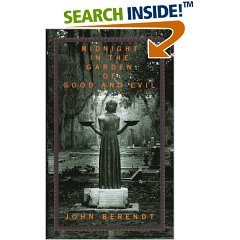
Okay, the only reason that I picked up John Berendt's 1993 book Midnight in the Garden of Good and Evil was because the branch library I was browsing in had apparently just weeded all of their 900s, and this was pretty much the only thing that remotely appealed. When it appeared back when this writer was in braces, it had instant appeal, became a bestseller, was mentioned on This Old House and was made into film starring Kevin Spacey and Jude Law. That's right. Kevin Spacey and Jude Law. This must be compelling stuff.

Well, I'm always a little skeptical of bestsellers, and I seem to recall some sort of controversy over Berendt's truthiness in his 'plot'. In fact, Amazon calls the book a novel, but various aspects of the book (the real life trial it centers on, the people it depicts) are real and therefore should put the book squarely on the nonfiction shelves--which was where I found it. Publisher's Weekly considers it a travelogue, if that helps. I think you see from the title what I would call it.

However you want to pigeonhole the book, Berendt should get a lot of credit for finding a good story and the characters to go with it. The title refers to some voodoo mischief relating to the trial of a wealthy antiques dealer accused of murdering his lover in a fit of passion. Actually, that's one of the trials: like everything else in Savannah, things seem to be done a little differently. So along with the recounting of the four trials, we also hear of the denizens of this odd little city: the slightly disturbed inventor with a deadly bottle of poison and a surprising knowledge of the city water supply; the industrious voodoo witch; and most notably the over-the-top, sashaying Lady Chablis, formerly known as Frank.

It's kind of fun to watch soaps for a few minutes, and I did enjoy Midnight for about 2/3 of the book. But by the third of fourth go through with the trial, I was beginning to get a little bored. Even throughly odd people can become rather pedestrian if you spend too much time with them. Coupled with my distrust of Berendt's narrative (I'm the sort that likes a thick, definite line between my fiction and my nonfiction), I can only summon up a weak 'eh' by way of an opinion. If you like quasi-novel type travelogues with a true crime mix, it's worth a look.

Thursday, July 06, 2006

Third time through...

I'm back in my native state, and for the occassion I thought I'd tackle a work by its most famous native author, F. Scott Fitzgerald. Well, actually the decision had more to do with the availablity of books while I was in the process of moving. For the week or so that I was in the nether world of being without official proof of residence I was also cut off from getting a library card, and thus had to rely on my own store of whatever's not currently boxed up. So, having already done the tenth-grade ritual of reading The Great Gatsby, I turned instead to Fitzgerald's 1934 novel, Tender Is The Night. In all honesty, I was a little skeptical that I would get through it, as I'd tried to complete it a few times in the seven or so years that it's been sitting on my shelf. Apparently all I needed to get through was to be jobless. Not the best way I'd like to get through some of the classics, but it worked in this case at least.

Written nine years after Gatsby, Tender Is The Night carries many of the same themes of the earlier book, but it seems much more of a personal book. The story centers on the decline of psychatrist Dick Diver, struggling to maintain his identity in the face of his wife Nicole's schizophrenia and wealth. That Fitzgerald's wife Zelda was undergoing treatment for the same illness at the time leads many to the conclusion that the novel is autobiographical. Whether or not this is the case, Tender Is The Night has a more personal feel than Gatsby. I can't say that I liked the later novel more than Gatsby--the earlier book had as much coolly beautiful prose with a little more plot--but Tender has a wistfulness that is lovely in its own way. Fitzgerald's writing is timeless, and for those who enjoy taking their time through well-developed characters and gorgeous prose will find it one of those classics that will reward the effort.

Tuesday, July 04, 2006

9/11, sans the flag waving.


Perhaps it is just me, but I really wish that Farrar, Straus and Giroux would have issued the hardcover version of William Langewiesche's perceptively written American Ground: Unbuilding the World Trade Center with the cover that eventually appeared on the paperback version. Not only is the paperback just more aestetically appealling in every way, but the gaping hole contrasting the soaring towers revealed by the depth mapping underscores the alien world Langewiesche discovers at what has become one of the most emotionally charged sections of real estate on earth. Langewiesche was the only journalist allowed full access to the World Trade Center site, chronicling the efforts to dismantle what amounts to the world's largest Jenga puzzle. But the central struggle goes far beyond the task of untangling WTC steel. Langewiesche writes of the tense encounters between civilian engineers, firefighters and police officers over the respect given (or lack of it) to the bodies of the victims. In the meantime, though, they manage to accomplish the heroic task of dismantiling the pile without losing any more lives.

Originally written for a three part series in The Atlantic Monthly, American Ground is a sensitive narrative of the uneasy future of the trade center site. The battles between the various parties and the very might needed to unbuild the site mirrors the urge to move on and rebuild versus the need to grieve. As of late, the tendency to claim the events of September 11, 2001 for various political motives or as a means of dicisiveness. Langewiesche avoids this by approaching this touchy subject with well-crafted prose that doesn't lag or devolve into patriotic inanity. The story of what happened at Ground Zero after the towers fell is just as revealing as the events during the attacks, and Langewiesche offers an intelligent perspective worth considering before we decide where we go from here.

Saturday, July 01, 2006

A less-than-sunny Italian sojourn.


Writing reviews of classics such as E. M. Forster's Where Angels Fear to Tread is probably one of the more obvious cases of unnecessary venting over a foregone conclusion: with a classic author, it's very unlikely that anything I or any other modern commentator would have to say about the book would have any bearing on whether or not it's good literature. Published in 1905, Angels was the first of Forster's novels to be published, and while not as successful as his other works, still bears the imprint of Forster's mastery that would become more apparent in Howard's End and A Passage to India.

I came to this novel after reading and thoroughly enjoying A Room With a View. Like the later novel, Angels centers around the experiences of English tourists encountering and being transformed by the Italian countryside. But unlike the humorous, sunny experiences of Lucy Honeychurch in Room, Angels takes a decidedly darker tone. The novel opens as widow Lilia Herriton and her chaperone Miss Abbott leave for Italy, much to the relief of Lilia's in-laws. After receiving word that Lilia has decided to marry an Italian, the family considers her as good as dead. But then a letter comes that Lilia is actually dead, and she has left a baby boy behind. Determined to raise the boy in England, Philip and Harriet Herriton, along with Miss Abbott, set out for Tuscany to collect him from his father. But complications arise, and without giving away the rest of the plot, let me just say that the book is the first of Forster's indictments of Edwardian society. I didn't like Where Angels Fear to Tread very much, but I get the sense that he had to write it before he composed his other works. The same sentiments are here, just in a less refined manner.

Sunday, June 25, 2006

A bona-fide star performance.


Unlike the last book I found while browsing at Memorial, Lee Server's new biography of Ava Gardner was not at all difficult to get through, in spite of its 500 pages of text. Ava Gardner: "Love Is Nothing" moves along swiftly and with as much spirit and vest as its subject. Today, Gardner isn't as well known an actress as her contemporaries Grace Kelly and Katharine Hepburn, but at the height of her career (late 1940s-50s), Gardner was the femme fatale of Hollywood. Her private life often topped her on-screen persona: much of her notoriety came from her affair with the then-married Frank Sinatra, but previous marriages to Mickey Rooney and Artie Shaw had already set the pattern for Gardner's heady and reckless love life.

Server has a lot to work with, detailing Gardner's rise from the North Carolina backwoods to through her rise to stardom and her slow decline as she became disillusioned following failed movies and love affairs. A combination of mistreatment by her studio (MGM almost made it a point to cast her in terrible films) and insecurity about her acting skills led Gardner to develop a legendary drinking habit, even for alcohol drenched Hollywood. In time, her destructive lifestyle would leave her restlessly wandering, searching for a permanent home and a man who wouldn't break her heart. In spite of her flaws though, Gardner remained a compelling figure. Server brings this aspect of the actress alive through a writing style that echoes Gardner's often ironic tone and extensive, explicative-filled quotes from Gardner and those who knew her.

I really didn't have much familiarity with Gardner's work, only having seen her in Mogambo and Show Boat a long time ago. In a way, though, Gardner's greatest dramatic turn was in the making of her own life, with held as much melodrama and triumph as any screen saga. Like the best type of director, Server frames his star so that her character can shine through to tell her own story. And for both author and star, it is a great performance.

Tuesday, June 20, 2006

Lose this book.


Believe me, I really wanted this book to be good. It's a clever concept, a collection of all the great books that might of been, a body of ethereal literature tantalizingly out of reach, by many of the greatest writers. So, it's ironic that The Book of Lost Books' should have the subtitle "An Incomplete History of All the Great Books You'll Never Read": for me, it will remain a book that's never read.

One thing about my reading: I make every effort to make it through all the books I begin. I really wanted to get through this one. And it started out fairly promising. The author, Stuart Kelly, writes in his introduction of his obsession with completeness, beginning at a very young age. Originally confined to novelizations of Dr. Who, Kelly's fixation soon extended to all aspects of literature, culminating in this volume. Beginning with Anonymous (who else?) and working through mostly western literature to postmodernist Georges Perec (d. 1982), Kelly muses over lost, never completed, never started, or otherwise not-with-us-here-today works. There are a few gems in his series of essays: the ancient Greek plays of Menander, praised by ancient authorities and thought lost for hundreds of years, were miraculously rediscovered in the twentieth century--only to reveal the great comic playwright was in actuality an overrated hack. Or the case of Camillo Querno, whose (mercifully) lost epic The Alexias was deemed so awful by Pope Leo X that Querno was awarded the post of poet laureate on the basis of his chutzpah in claiming authorship of such trash than from any artistic merit.

Unfortunately, such good moments are buried in dense, uninteresting verbiage that quickly becomes tedious. I pressed on into the account of Gottfried Vilhelm von Leibniz's Universal Encyclopedia before Kelly's pontificating just became too much. For those serious readers (and I mean those who read their Euripides in the original Greek), Kelly's book might hold their interest; for those not interested in dense, speculative prose, leave The Book of Lost Books on the shelf.